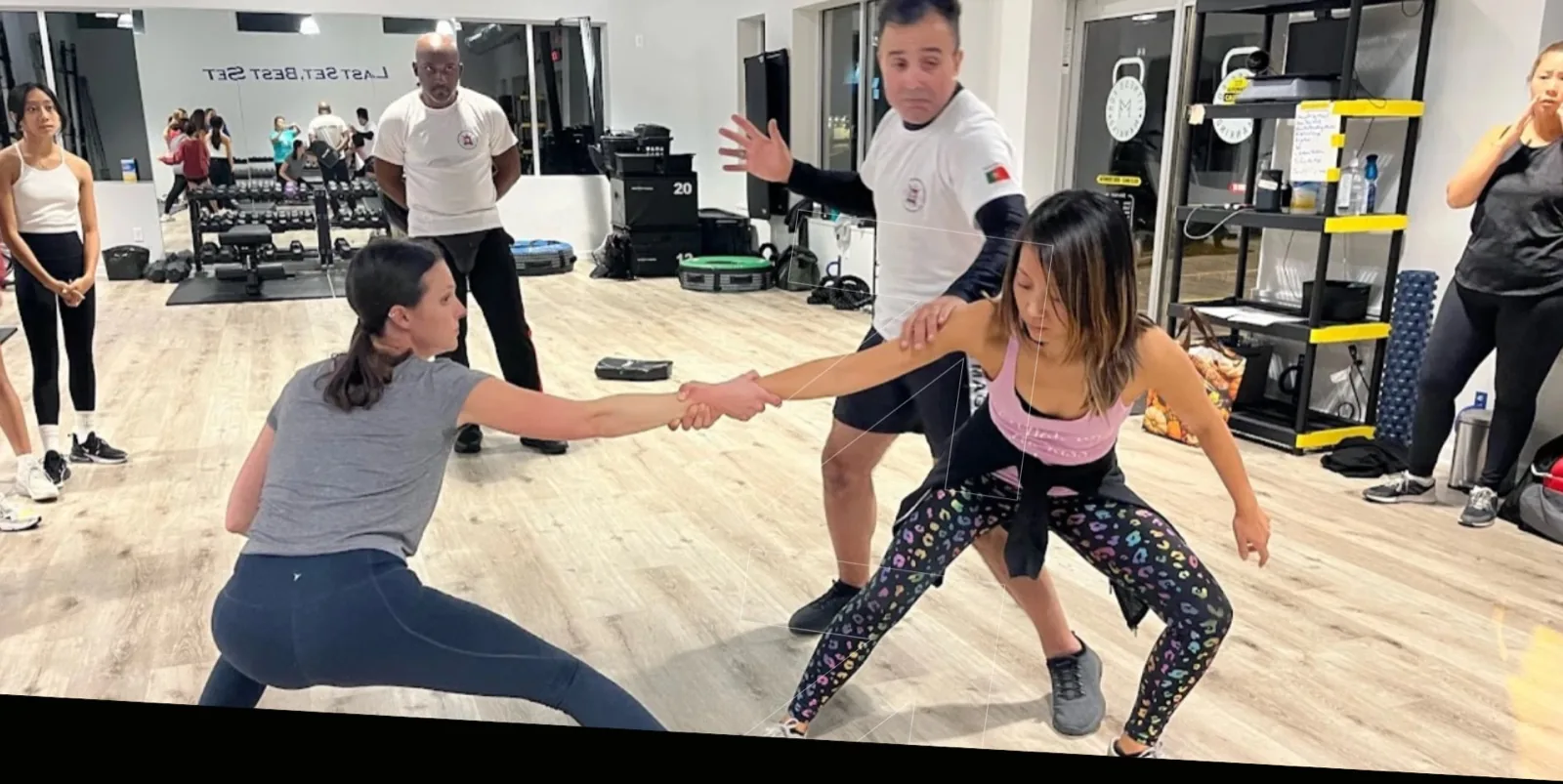
Most self-defense advice for women is a list of moves. Groin kick. Eye gouge. Aim for the throat. "Be aware of your surroundings." None of it is wrong. It's just not the thing that actually keeps you safe — and after years of teaching this, with a room that's about 40% women, I can tell you the women who get genuinely safer almost never do it by memorizing a move.
They do it by changing three things: how they use their voice, how they hold a boundary, and whether they've drilled a real response enough times that their body owns it. Here's what that means — what the data actually says, and what's worth your time.
What actually happens (it's not the parking-lot stranger)
The picture in your head is probably a stranger in a dark lot with a weapon. The data tells a different story. National violence research from the National Institute of Justice and the CDC consistently shows the most common physical assaults against women are grabs, shoves, and being pushed or restrained — close range, often by someone she knows. Weapons are near the bottom of the list, not the top.
That matters, because it tells you what to train. Not a flashy disarm you'll never use. The un-glamorous stuff: breaking a wrist or collar grab, staying on your feet when someone shoves you, getting back up off the ground, creating distance. Train your actual risk, not the movie version of it.
The skill nobody trains: your voice
We run a women's workshop a few times a year. At the end, everyone writes what they learned on a sticky note. Here's the thing — almost none of them write down a technique. They write down this:
"I learned to be more vocal." · "Stop being too nice." · "Be more assertive and less polite." · One note just said: "I'm Strong!!"
That's the real lever, and it's the one most advice skips. A lot of women have spent a lifetime being trained to be accommodating — to not make a scene, to soften, to be polite. An attacker reads that in about two seconds. The single most effective thing you can do early is the opposite of polite: a loud, flat, early "NO. BACK UP." with your hands up and your feet set. It ends more situations than any strike, because it tells someone testing you that you are not the easy target they were hoping for.
The goal isn't to be more afraid. It's to be less polite when your gut says something's off. De-escalation and boundary-setting is a trained skill, same as any other.
Why a list of moves fails you
Here's the uncomfortable truth about the one-afternoon class: you'll walk out with five moves and forget four of them inside a month. Under real stress, you don't rise to the occasion — you fall to the level of what you've actually drilled. If a response isn't automatic, it isn't there when adrenaline hits.
That's why a weekend seminar can be worse than nothing — it can hand you false confidence. A genuinely owned response takes about three months of training twice a week to build. Not because we're slow, but because that's how long it takes for your body to stop needing your brain's permission. The capability has a lead time, and you don't get to pick when you'll need it.
What to actually train — in order
If you're starting, here's the priority order — built around what's most likely, not what looks dangerous on YouTube:
- Voice and boundaries — the "NO, back up," the assertive posture, the early exit. Your first and most-used line of defense.
- Breaking grabs and chokes — wrist, collar, from behind, against a wall. The most common physical contact, drilled until it's reflex.
- Staying up and getting up — keeping your feet when pushed, and getting off the ground if you go down.
- Awareness and the freeze — reading a situation early, and training the action that breaks the freeze response.
- Pressure-testing — drilling all of it with a partner who doesn't fully cooperate, so it holds up under real adrenaline.
So, are women's self-defense classes worth it?
Yes — with one condition. A class is worth it if you can keep training. A one-off seminar is a fine first taste, but it's the ongoing reps that build the thing that actually protects you. That's why our women's Krav Maga is a permanent class you can train every week, in a room where you won't be the only woman. We also publish our own student progress data, because "trust me" isn't proof.
If you take one thing from this: don't shop for the perfect move. Find a place you can train consistently, with real partners, that lets you practice your voice as hard as your hands.